Embroidery Machines for a Small Business: How to Choose by What You Sell
Embroidery machines for a small business, sorted into home, commercial single-needle, and multi-needle tiers from manufacturer documents, with warranty terms to check before you sell.
 By Jordan Hale
Updated November 16, 2026
We earn a commission if you buy through links on this page, at no extra cost to you. Commissions do not affect how we rate products. As an Amazon Associate I earn from qualifying purchases. Learn more.
The right embroidery machine for a small business depends on what you will sell: a few personalized gifts a week, caps for local teams, or batches of multicolor logos. Several lists of embroidery machines for small business still recommend models Brother has stopped selling, such as the PE535, which Brother’s U.S. store marks discontinued. This guide sorts current machines into three tiers using manufacturer documents checked October 12 and 13, 2026, and flags one warranty detail that matters if you sell what you stitch. We have not used these machines ourselves.- Side business, personalized items, flat goods: a home single-needle machine with a 5″ x 7″ field, such as Brother’s PE900 or SE2000.
- Caps or sleeves on a regular basis, mostly one or two colors: a commercial single-needle machine with a cap frame, such as Brother’s PRS100 or PR1X, sold through dealers (on October 20, 2026, Brother’s U.S. store also listed the PRS100 for sale).
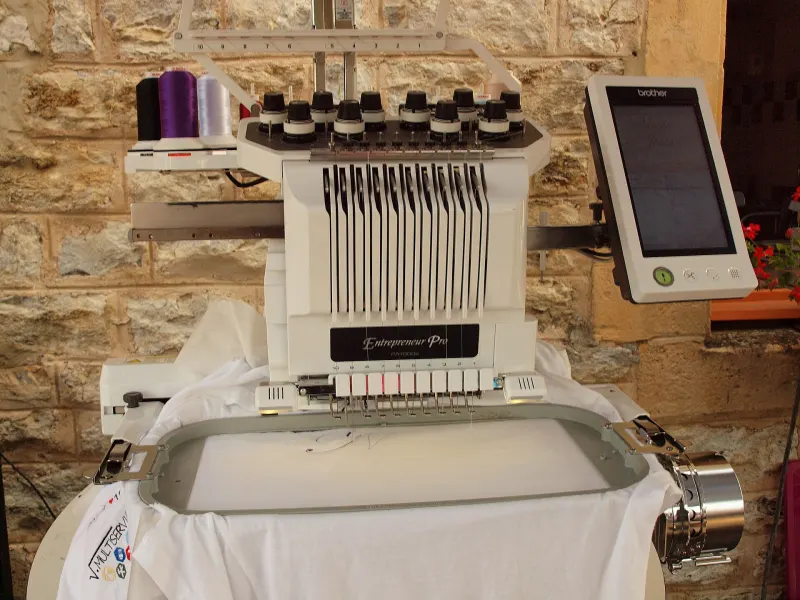
- Batches of multicolor logos: a multi-needle machine, such as Brother’s PR680W or Ricoma’s EM-1010.
Check the warranty before you sell what you stitch
The Singer limited warranty linked from the SE9180 page says: “This warranty is for household (non-commercial) use.” That is the clause for the machine we checked; other Singer models may come with different terms, and the clause does not spell out every kind of paid work. If you plan to sell what you make on a Singer home machine, read the warranty for your exact model and ask Singer how it applies. We searched the full text of Brother’s Standard and Premium limited warranties and found no mention of commercial or business use either way. That silence does not show that business use is covered, or that it is excluded. If you plan to sell what you stitch on a Brother machine, ask Brother or the authorized seller to confirm in writing how the warranty applies to business use. Ricoma, which sells its multi-needle machines direct, lists a 1-year warranty option and an optional 5-year plan.The three tiers
| Home single-needle | Commercial single-needle | Multi-needle | |
|---|---|---|---|
| Examples (current) | Brother PE900, SE2000 | Brother PRS100, PR1X | Brother PR680W (6 needles); Ricoma EM-1010 (10 needles) |
| Max flat embroidery area | 5″ x 7″ | 8″ x 8″ (PRS100); 12″ x 8″ (PR1X) | 12″ x 8″ (PR680W); 12.2″ x 8.3″ (EM-1010) |
| Top speed listed | 650 stitches per minute | 1,000 per minute flat; 600 on cap frames | 1,000 per minute |
| Caps | No cap frame documented | Cap frame capability listed | Cap frame capability listed; Ricoma includes cap rings and a cap driver |
| Color changes | Rethread by hand | Rethread by hand | Switches among threaded needles |
| Weight | About 18 to 21 lb | About 67 to 68 lb | About 84 lb (PR680W); 99 lb (EM-1010) |
| Accessories to plan for | Top thread and stabilizer (not in the box) | Cap frames sold separately by Brother | Ricoma includes 2 cap rings and a cap driver; stand sold separately |
| Service | Brother authorized service centers; you pay shipping for warranty work | Sold through authorized dealers; ask the dealer who services it | Brother PR: through dealers; Ricoma: ask Ricoma how service is handled near you |
| Where sold, price | Brother's store: PE900 and SE2000 in the upper band of home machines; check current prices | Authorized dealers; no price on Brother’s site | PR680W through dealers, no price published; EM-1010 Core bundle priced several times higher than a home machine |
What to weigh besides the machine tier
- How many items a week you expect to stitch, and how many of them repeat the same design.
- How many thread colors your typical design uses. On a single-needle machine, each color is a stop to rethread.
- Whether you need caps, sleeves, or other tubular items, which need a machine and frames made for them.
- The largest design you sell, compared with each machine’s maximum embroidery area.
- What happens when the machine is down. Warranty work on Brother’s home machines goes through an authorized service center, and you pay to ship the machine there.
- Space and setup. Commercial and multi-needle machines weigh 67 to 100 lb or more, and some need a stand.
What top speed means for your schedule
Machine speed is easier to plan with when you turn it into minutes. The chart below divides a 10,000-stitch design, an example size we chose, by the top speeds the makers list: 400 stitches per minute in Brother’s manuals for its 4″ x 4″ home machines (PE545, SE700), shown for comparison; 650 for its 5″ x 7″ home machines (PE900, SE2000); 600 for Brother’s commercial single-needle machines on cap frames; and 1,000 for commercial machines on flat frames. It is a floor, not a forecast: real jobs also include hooping, thread changes, trims, and any slower speed you choose for the fabric.Tier 1: start with a home machine
A home machine keeps the investment small while you find out what sells. Brother’s PE900 embroiders only, with a 5″ x 7″ field, 193 designs, Wi-Fi and USB design loading, and a 650 stitches-per-minute top speed; the SE2000 adds a full sewing machine to the same field. Both are sold on Brother’s store with Brother’s 1/2/25 Year Limited Warranty. The limits for business work are the 5″ x 7″ field, hand rethreading for every color, and no documented cap frame. Read our Brother PE900 review (EMS 7.3) and Brother SE2000 review (EMS 7.7).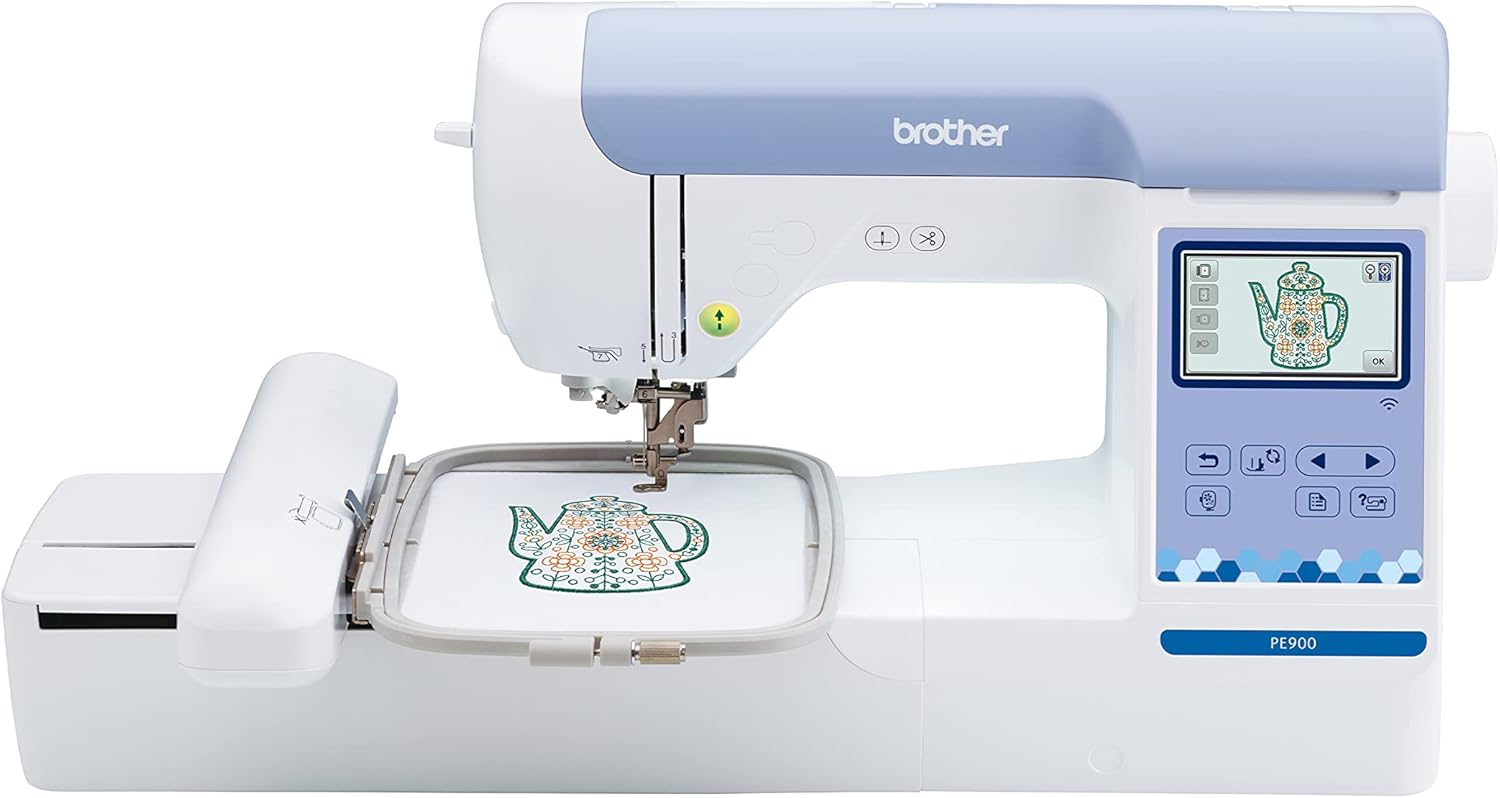
Brother PE900
- 5 in x 7 in
- Embroidery only
- 193 designs
Good fit if
- You only need embroidery and want a 5" x 7" field
- You want wireless design transfer
Skip it if
- You also want a sewing machine in the same unit
- Your designs fit in 4" x 4" and you want a smaller-field machine
Check price on AmazonRead our full review
Paid link. We may earn a commission.
Tier 2: commercial single-needle for caps and bigger fields
Brother’s PRS100 and PR1X are single-needle machines sold through authorized dealers; on October 20, 2026, Brother’s U.S. store also listed the PRS100 for sale. Brother lists cap frame capability for both, a free arm for caps, sleeves, and bags, and speeds up to 1,000 stitches per minute on flat frames and 400 to 600 on cap frames. The PR1X stitches up to 12″ x 8″; the PRS100 up to 8″ x 8″. Both weigh about 67 to 68 lb and carry Brother’s Premium Limited Warranty: 2 years parts and labor, 6 years electronics, 25 years chassis. Brother sells cap frames separately; see our hats guide for which frames Brother lists for each machine.Tier 3: multi-needle for batches

Discontinued machines you may still see recommended
When we rechecked on October 19, 2026, Brother’s U.S. store marked these as discontinued: the PE535, SE600, SE625, and PE800 (see, for example, Brother’s PE535 and SE600 pages). Some other models, such as the SE630 and LB5500, were out of stock but not labeled discontinued, and the NQ1700E and PR1060W were listed as current, sold through dealers. Discontinued means Brother no longer sells it new on its store; dealers may still have stock, and used machines are sold too. Check availability, warranty terms, and parts support before you build a business on one.Questions to ask before you buy
- Does the warranty cover the machine if you sell what you make?
- Which cap frame or other frames fit, and are they included in the price?
- Who services the machine near you, and how long does service take?
- What training comes with the purchase?
What we could not assess
- Stitch quality, reliability, and real production speed: we have not used these machines.
- Dealer prices and package contents for Brother’s PR models.
- Whether Brother’s warranties cover business use, which their text does not address.
- How much any embroidery business earns; that depends on your products, prices, and customers.
FAQs
Does a Brother home machine’s warranty cover selling what I stitch?
We searched the full text of Brother’s Standard and Premium limited warranties and found no mention of commercial or business use either way. That silence does not show that business use is covered or excluded, so ask Brother or the authorized seller to confirm in writing how the warranty applies.
Can a home embroidery machine stitch caps?
In the three-tier table on this page, no cap frame is documented for the home single-needle machines (PE900, SE2000). The commercial single-needle machines and the multi-needle machines list cap frame capability, and Brother sells its cap frames separately.
How long does a design take at the top speeds the makers list?
For a 10,000-stitch example design, the minimum stitching time is 10.0 minutes at 1,000 stitches per minute, 15.4 minutes at 650 and 25.0 minutes at 400. These are arithmetic floors; real jobs also include hooping, thread changes and trims.
Related guides
Sources
- Brother USA product pages and specification tables for the PE900, SE2000, PRS100, PR1X, PR680W, and NQ1700E (checked October 12 and 13, 2026; PRS100 store listing checked October 20, 2026).
- Brother Limited Warranty (Standard) and Brother Limited Warranty (Premium).
- SVP Worldwide Limited Warranty for Singer, linked from Singer’s SE9180 product page.
- Ricoma EM-1010 product page: specifications, warranty options, price, stand, and delivery time (checked October 12, 2026).
- Brother operation manuals for the PE900 (888-K80) and SE2000 (888-K10): maximum embroidery speed.
About the author

Jordan Hale is a pen name used by the site's operator. Jordan researches and edits the buying guides at Embroidery Machine Scout. Jordan compiles manufacturer specifications, user manuals, and patterns in owner feedback to compare home and small-business embroidery machines. Jordan does not physically operate the machines reviewed here; every recommendation states its sources and the date they were checked.